What is Ethnography?
View this page at its primary location.
You can read and download my in-depth discussion of contemporary ethnographic approaches to fieldwork as well as read and download my guide to ethnography and ethnographic fieldwork, including lists of questions and tips for fieldwork notes. If you would like to easily use and cite my work on this subject, these are two easy ways to go.
The term ethnography has come
to be equated with virtually any qualitative research project where the intent is to provide a detailed, in-depth description of
everyday life and practice. This is sometimes referred to as "thick
description" -- a term attributed to the anthropologist Clifford Geertz
writing on the idea of an interpretive theory of culture in the early
1970s (e.g., see The Interpretation of Cultures, first
published as a collection in 1973). The use of the term
"qualitative" is meant to distinguish this kind of social science
research from more "quantitative" or statistically oriented research.
The two approaches, i.e., quantitative and qualitative, while often
complementary, ultimately have different aims.
While an ethnographic approach to social research is no longer purely that of the cultural anthropologist, a more precise definition must be rooted in ethnography's disciplinary home of anthropology. Thus, ethnography may be defined as both a qualitative research process or method (one conducts an ethnography) and product (the outcome of this process is an ethnography) whose aim is cultural interpretation. The ethnographer goes beyond reporting events and details of experience. Specifically, he or see attempts to explain how these represent what we might call "webs of meaning" (Geertz again), the cultural constructions, in which we live.
Ethnographers generate understandings of culture through representation of what we call an emic perspective, or what might be described as the "'insider's point of view." The emphasis in this representation is thus on allowing critical categories and meanings to emerge from the ethnographic encounter rather than imposing these from existing models. An etic perspective, by contrast, refers to a more distant, analytical orientation to experience.
An ethnographic understanding is developed through close exploration of several sources of data. Using these data sources as a foundation, the ethnographer relies on a cultural frame of analysis.
Long-term engagement in the field setting or place where the ethnography takes place, is called participant observation. This is perhaps the primary source of ethnographic data. The term represents the dual role of the ethnographer. To develop an understanding of what it is like to live in a setting, the researcher must both become a participant in the life of the setting while also maintaining the stance of an observer, someone who can describes the experience with a measure of what we might call "detachment." Note that this does not mean that ethnographers cannot also become advocates for the people they study. Typically ethnographers spend many months or even years in the places where they conduct their research often forming lasting bonds with people. Due to historical development and disciplinary biases, in the past most ethnographers conducted their research in foreign countries while largely ignoring the potential for work right here at home. This has meant that much of the ethnography done in the United States today is now being done outside of its disciplinary home. Increasing numbers of cultural anthropologists, however, have begun doing fieldwork in the communities where they themselves live and work.
Interviews provide for what might be called "targeted" data collection by asking specific but open-ended questions. There is a great variety of interview styles. Each ethnographer brings his or her own unique approach to the process. Regardless, the emphasis is on allowing the person or persons being interviewed to answer without being limited by pre-defined choices -- something which clearly differentiates qualitative from more quantitative or demographic approaches. In most cases, an ethnographic interview looks and feels little different than an everyday conversation and indeed in the course of long-term participant-observation, most conversations are in fact purely spontaneous and without any specific agenda.
Researchers collect other sources of data which depend on the specific nature of the field setting. This may take the form of representative artifacts that embody characteristics of the topic of interest, government reports, and newspaper and magazine articles. Although often not tied to the site of study, secondary academic sources are utilized to "locate" the specific study within an existing body of literature.
Over the past twenty years, interest has grown within anthropology for considering the close relationship between personal history, motivation, and the particulars of ethnographic fieldwork (e.g., see Hoey & Fricke 2007). It is undeniably important to question and understand how these factors have bearing on the construction of theory and conduct of a scholarly life. Personal and professional experiences, together with historical context, lead individual researchers to their own particular methodological and theoretical approaches. This too is an important, even if unacknowledged, source.
Ethnographic fieldwork is shaped by personal and professional identities just as these identities are inevitably shaped by individual experiences while in the field. Unfortunately, the autobiographical dimension of ethnographic research has been downplayed historically if not discounted altogether. This is mostly understandable given a perceived threat to the objectivity expected of legitimate science, to reliability of data, and to integrity of our methodology, if we appear to permit subjectivity to intervene by allowing the ethnographer’s encumbered persona to appear instead of adhering to the prescribed role of wholly dispassionate observer.
Most anthropologists today point to Bronislaw Malinowski, author of such landmark ethnographies as Argonauts of the Western Pacific (first published in 1922), as a kind of founding father to ethnographic fieldwork, the practice of “participant-observation.” Malinowski’s early twentieth century ethnographies were written in a voice removed and utterly unrevealing about the nature of the ethnographer and his relationship to people studied. Since Malinowski’s time, the personal account of fieldwork has been hidden away in notes and diaries. These “off the record” writings document the tacit impressions and emotional experiences without which we cannot, as ethnographers, fully appreciate and understand the project of our research itself. Malinowski’s diaries were published after his death in a revealing autobiographical account of his inner life while in the field (A Diary in the Strict Sense of the Term, first published in 1967). We learn in his diaries that, among other details, Malinowski longed to write great novels even as his scientific writing effectively defined the practice of cultural anthropology for much of the twentieth century.
Of many important lessons for anthropologists,
Malinowski’s diaries hold two especially relevant ones here. First of
these is that, at its heart, ethnographic writing is a means of
expressing a shared interest among cultural anthropologists for telling
stories – stories about what it means to be human. The other is that
the explicit professional project of observing, imagining and
describing other people need not be incompatible with the implicit
personal project of learning about the self. It is the honest truth of
fieldwork that these two projects are always implicated in each other.
Good ethnography recognizes the transformative nature of fieldwork
where as we search for answers to questions about people we may find
ourselves in the stories of others. Ethnography should be acknowledged
as a mutual product born of the intertwining of the lives of the
ethnographer and his or her subjects (for more on these points, please
see Hoey 2008).
Engaging Ethnographies
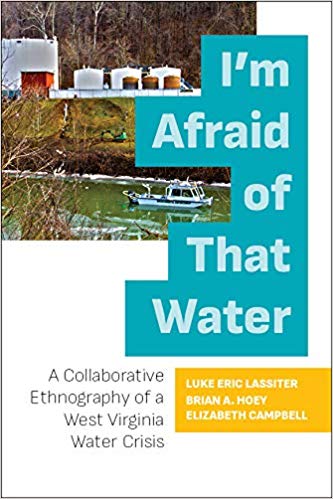
I'm Afraid of that Water
On January 9, 2014, residents across Charleston, West Virginia, awoke to an unusual licorice smell in the air and a similar taste in the public drinking water. That evening residents were informed the tap water in tens of thousands of homes, hundreds of businesses, and dozens of schools and hospitals—the water made available to as many as 300,000 citizens in a nine-county region—had been contaminated with a chemical used for cleaning crushed coal.
This book tells a particular set of stories about that chemical spill and its aftermath, an unfolding water crisis that would lead to months, even years, of fear and distrust. It is both oral history and collaborative ethnography, jointly conceptualized, researched, and written by people—more than fifty in all—across various positions in academia and local communities. I’m Afraid of That Water foregrounds the ongoing concerns of West Virginians (and people in comparable situations in places like Flint, Michigan) confronted by the problem of contamination, where thresholds for official safety may be crossed, but a genuine return to normality is elusive.
Available from West Virginia University Press.
Lifestyle Migration in the American Middle Class
"Do you get told what the good life is, or do you figure it out for yourself"?Posed by a middle-aged lifestyle migrant who left a corporate career, this question invokes the theme of Opting for Elsewhere that emerges from stories of people who chose relocation as a way of redefining themselves and reordering work, family, and personal priorities. This is a book about the impulse to start over. The accounts presented involve new expressions of old dreams, understandings, and ideals. Whether downshifting from stressful careers or the victims of downsizing from jobs lost in a surge of economic restructuring, lifestyle migrants seek refuge in places that seem to resonate with an idealized, potential self. Choosing the option of elsewhere and moving as a means of remaking self through sheer force of will are basic facets of American character forged in its history as a developing nation of immigrants with a seemingly ever-expanding frontier. Stories told here are parts of a larger moral story about what constitutes the good life at a time of economic uncertainty coupled with shifting social categories and cultural meanings. Brian Hoey provides an evocative illustration of the ways these sweeping changes impact people and the places that they live and work as well as how both react—devising strategies for either coping with or challenging the status quo. This stirring portrait of starting over in the heartland of America will initiate fruitful discussion about where we are going next as an emerging postindustrial society.
Available from Vanderbilt University Press.